

27 Oct Landscape Lighting Design Guide: Fixture Types and Where Each One Goes
Good landscape lighting comes down to a handful of fixture types, each with one job. Path lights guide the way, uplights give trees and walls depth, downlights soften open areas from above, wall and step lights make changes in elevation safe, and accent fixtures add color where you want it. The craft is not in owning more fixtures. It is in putting the right one in the right place and leaving the rest of the yard dark. Here is how each type works, where it goes, and what to avoid.
Start With Purpose, Not Fixtures
Before choosing a single fixture, decide what each light is for. DarkSky and the Illuminating Engineering Society’s five principles for responsible outdoor lighting are a useful filter: light should be useful, aimed only where it is needed, no brighter than necessary, controlled by timers or sensors, and warm in color where possible. A fixture that fails those tests probably does not belong in the plan. That restraint is also what keeps a design from washing out the features you are trying to show off.
If you are still deciding whether lighting is worth adding, start with our post on five reasons Long Island homeowners add landscape lighting. If you are ready to plan, keep reading.
The Fixture Types and Where Each One Goes
Path Lights
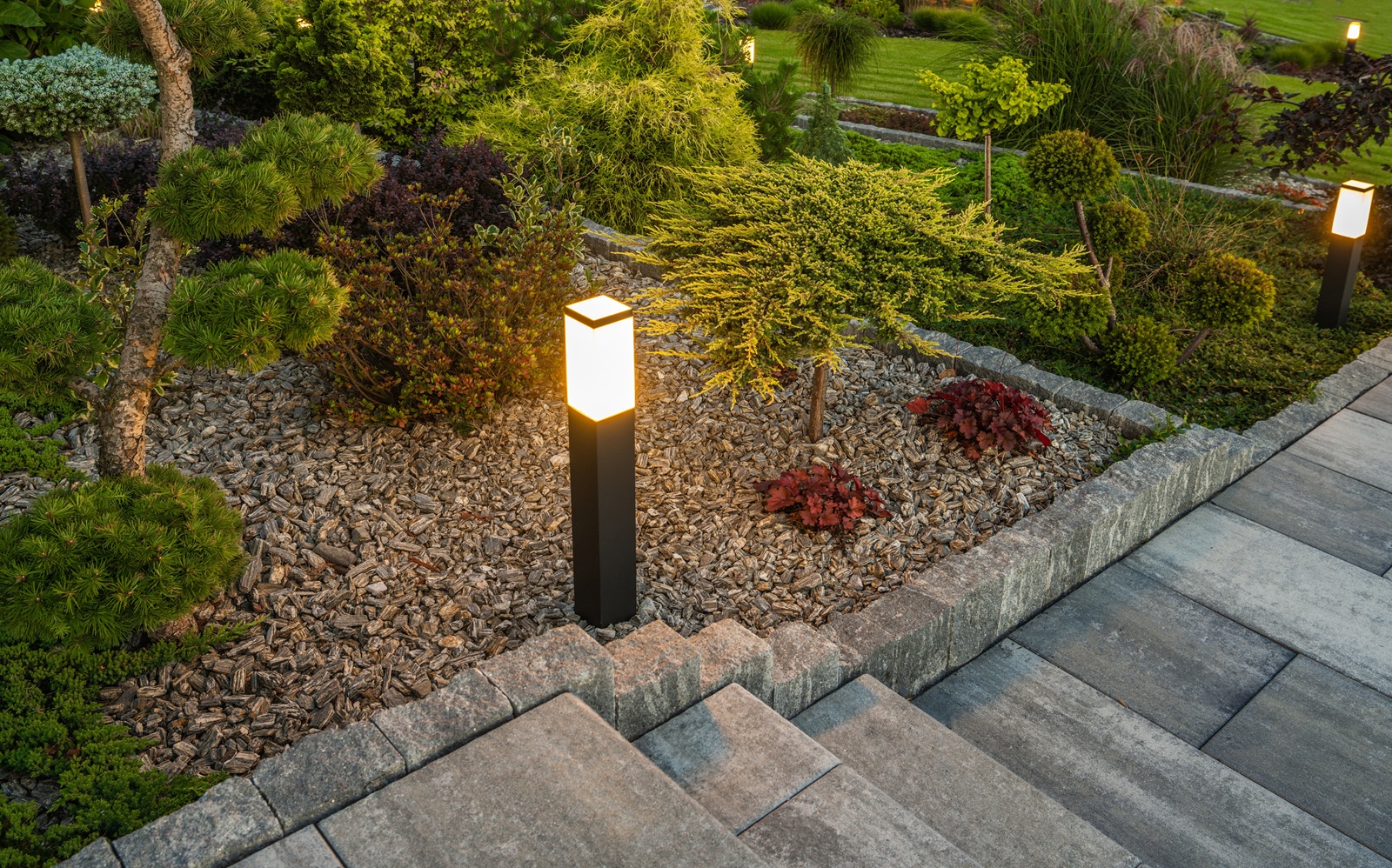
What they do. Guide people along walkways, driveways, and garden edges. Where they go. Along the route, staggered from side to side with even spacing between fixtures, as lighting manufacturers like FX Luminaire advise. A commonly cited starting point is about six to eight feet between lights, adjusted for how bright the fixtures are and how much the path curves. Avoid. Placing them too close together or too bright, which creates a cluttered, pooled look instead of a guided one.
Uplights for Trees and Facades
What they do. Light a tree, column, or wall from below to add shape and depth after dark. Where they go. A few feet from the base of a tree, angled up into the canopy. Larger trees often look best with two or three fixtures at different angles. Facades and stone walls take uplights placed close to the surface. Avoid. Aiming a fixture toward a seating area or a window, which creates glare instead of drama. Shielding and careful aiming are what the targeted principle is about.
Downlights and Moonlighting
What they do. Cast soft, natural looking light from above, the way moonlight filters through branches. Where they go. Mounted high in mature trees or under eaves and angled down onto patios, beds, and walkways. FX Luminaire’s guide describes the technique as placing fixtures high in trees so light filters down through the limbs and leaves. Avoid. Overdoing the brightness. Moonlighting works best when it is subtle. Because it depends on secure mounting, hardware and cable routing should be built for Long Island wind and wet snow.
Wall Washing and Grazing
What they do. Wall washing spreads an even glow across a flat surface or a long hedge. Grazing places the light very close to a textured surface, such as stone or brick, so shadows bring out the texture. Where they go. Washing fixtures sit farther back from the surface to spread the light. Grazing fixtures sit close and aim up the surface. Avoid. Washing a textured stone wall, which flattens the detail you wanted to show, or grazing a smooth wall, which tends to highlight every imperfection.
Step and Hardscape Lights
What they do. Make steps, ledges, and changes in elevation easy to see. Where they go. On risers or under step edges, along retaining walls and seat walls, and at deck edges. Why it matters. The National Safety Council reports that more than 8.8 million people were treated in emergency rooms for fall related injuries in 2023, and it lists good lighting indoors and out among its basic fall prevention steps. Avoid. Leaving steps dark because the path lights probably reach them. Elevation changes deserve their own light.
Accent and Color Changing Fixtures
What they do. Add a deliberate pop of color, or let you change the look for a season or occasion. Where they go. On a specimen tree, an entry feature, or a single focal point rather than across the whole yard. Avoid. Using saturated colors year round. Warm white is the better everyday setting, and DarkSky’s principles favor warmer colors where possible. Color changing LEDs are for the moments you choose, such as the holidays.
Build the Design in Layers
A simple way to keep a design disciplined is to build it in three layers and stop when each one is doing its job.
- Safety first. Path lights, step lights, and lighting at entrances.
- Then features. Uplights or wall lights for the one or two trees or architectural details you actually want people to notice.
- Then atmosphere. Downlights or moonlighting over the spaces you use in the evening, such as a patio or deck.
Many properties are well served by the first two layers alone.
What Changes Fixture Choices on Long Island
Coastal properties, such as those in Southampton or Long Beach, deal with salt air and humidity that wear faster on lower quality fixtures, so fixtures should be rated for those conditions. Inland properties in places like Smithtown or Huntington often have dense tree cover, which changes how light travels across a yard and can make downlighting especially effective.
Seasons matter too. A layout designed around summer foliage can look different once deciduous trees drop their leaves in late fall, sometimes exposing fixtures that were meant to stay tucked behind greenery. Timer and transformer based controls, which fit DarkSky’s controlled principle, keep lights on only when they are useful.
What to Expect From a Design Walkthrough
Lighting decisions are best made in the conditions the fixtures will actually work in, so a good design process starts after dark.
- An evening walkthrough of your property, whenever possible, to see which trees, entries, and features deserve light.
- A layout that plans wiring routes and transformer placement to minimize disruption to your landscaping and irrigation system.
- Installation of each fixture at the height and angle needed for the effect.
- An evening test of the full system, with fixtures adjusted on the spot until it matches the plan.
When to Call McCormack Irrigation
McCormack Irrigation designs and installs low voltage landscape lighting for homes and businesses throughout Suffolk and Nassau County, from path lights to color changing LED fixtures, and our team can service your system over time. We have served Long Island since 2001 with our own in-house crews, and our work is reflected in an A+ rating with the Better Business Bureau and a 4.9 out of 5 rating across more than 330 Google reviews. To plan a layout for your property, call (631) 744-1500 or contact us online to schedule an evening walkthrough.