


30 Sep Fall Sprinkler Winterization Checklist for Suffolk County Homeowners
Winterizing an irrigation system in Suffolk County comes down to a short list of steps done in the right order: shut off the supply, protect the backflow device, blow every zone dry with compressed air, drain what the air cannot reach, and set the controller so nothing runs until spring. This checklist walks through everything a homeowner in Commack, Miller Place, Ronkonkoma, Babylon, Coram, Selden, Smithtown, Huntington, or out east in East Hampton should do before, during, and after a professional blowout, so the system comes through a Long Island winter without cracked pipes or split fittings.
McCormack Irrigation has winterized systems across Suffolk County and Nassau County since 2001. Our winterizing service is performed by trained, uniformed, in-house crews, never subcontractors, which is one reason the company holds a 4.9 out of 5 rating across 328 Google reviews and an A+ rating with the Better Business Bureau.
Before the Crew Arrives: 4 Things to Do Now
A few minutes of prep makes the appointment faster and helps the technician catch problems while the system is still under water pressure.
- Locate your shutoff and backflow device. On most Long Island homes the irrigation shutoff is in the basement or crawl space near the water meter, and the backflow preventer sits outside above grade. Clear boxes, bins, and firewood away from both so the crew has room to work.
- Note any zones that were acting up. A head that stopped rotating, a zone that runs weak, or a soggy spot near a valve box is worth mentioning. Our technicians can often diagnose a problem during the blowout and schedule a sprinkler repair before spring.
- Mark heads hidden by fall growth or leaves. Late-season grass and leaf cover hide pop-ups. If you know where the heads along the driveway or bed edges are, a quick flag or a note helps the crew confirm every head clears.
- Keep the controller powered and accessible. The technician needs to run each zone from the controller during the blowout. Do not unplug it or switch it off ahead of time.
What a Professional Blowout Covers
The blowout is the core of the job. Compressed air pushes water out of every line and head so nothing is left to freeze and expand. Here is what happens, step by step.
- Water supply is shut off. The irrigation shutoff inside the house is closed, and the system is depressurized before any air is introduced.
- Backflow device is isolated. The ball valves on either side of the backflow preventer are closed so air never passes through the assembly. Manufacturers such as Hunter Industries state that compressed air should not be blown through a backflow device, because the internal checks and seals are not designed for it. The crew connects the compressor to a fitting downstream of the backflow instead. You can read the manufacturer’s guidance in Hunter’s winterization technical bulletin.
- Each zone is blown out at a controlled pressure. The crew opens the farthest or highest zone first and works back toward the compressor. Air pressure is regulated for the pipe type in the ground. Hunter lists 50 PSI as the maximum for polyethylene pipe and 80 PSI for PVC, and most Suffolk County residential systems run on poly. Zones are cycled in short bursts rather than one long blast, because dry pipe under continuous air builds friction heat that can damage fittings.
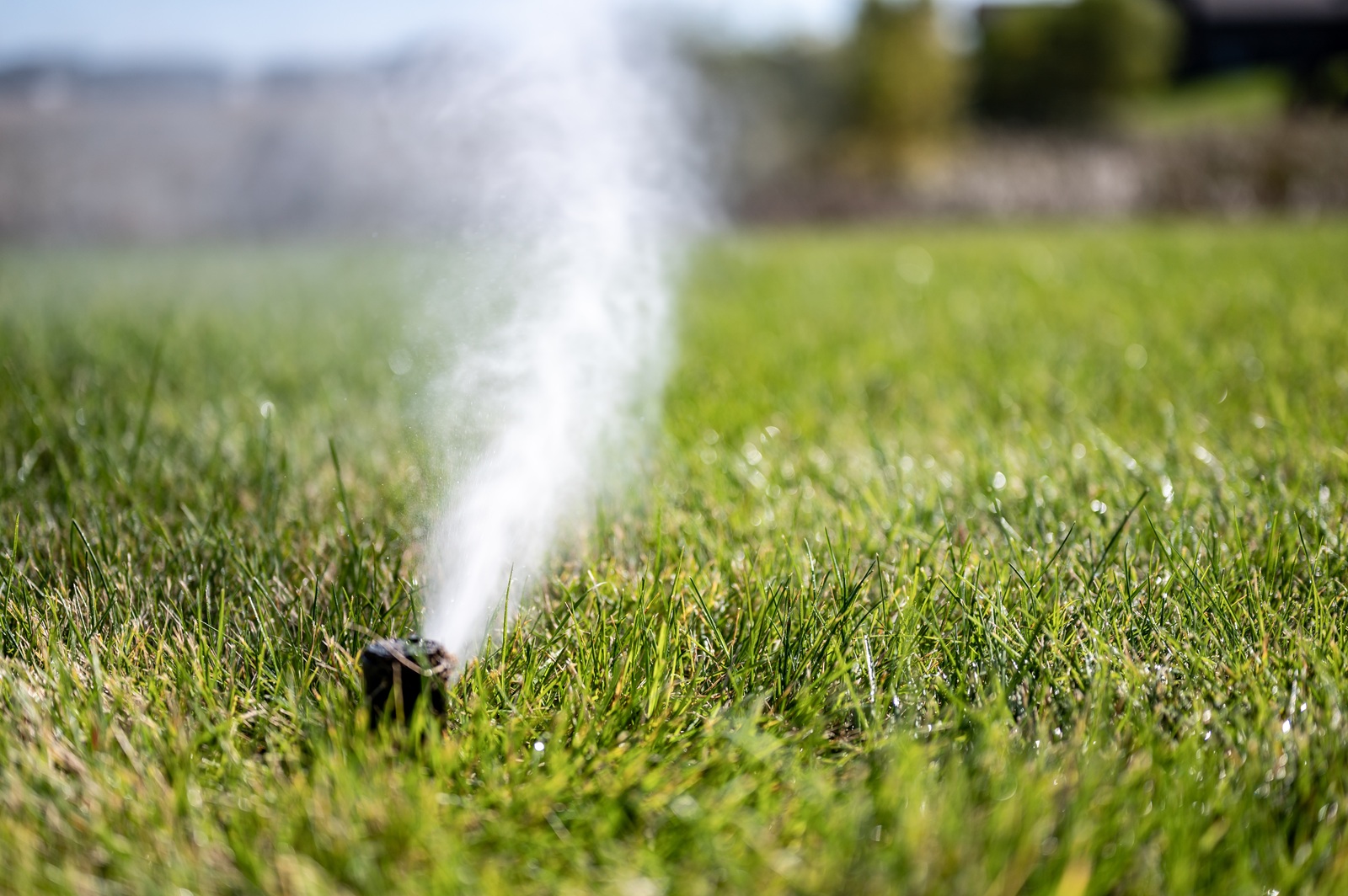
- Heads, fittings, solenoid valves, and manifolds are cleared. Each zone runs until only a fine mist comes from the heads. The technician watches every head pop up and clear, which is also a good check that no head is stuck or broken.
- Exposed plumbing and hose bibs are drained. Any above-ground piping, the backflow assembly itself, and outdoor hose bibs tied to the irrigation line are drained separately after the zones are dry.
Controller, Backflow, and Hose Bib Steps
Once the lines are empty, three smaller items finish the job. Skipping any of them is a common cause of spring surprises.
- Set the controller correctly. The controller is switched to “off” or “rain” mode rather than unplugged, so the program and date stay in memory and the spring turn-on is faster. Battery-backed controllers get a fresh battery if needed. If you have a smart controller, the app schedule is paused as well.
- Leave the backflow in the winter position. After the blowout, the isolation ball valves on the backflow are opened and closed several times to release trapped water, then left partially open at roughly a 45 degree angle with the test cocks open. This lets any remaining water expand without cracking the body. Your backflow will need its annual test again in spring, which our New York State certified testers handle through the backflow testing service, with paperwork filed with your local water district.
- Drain and disconnect hose bibs. Remove hoses, open the bib, and if there is an interior shutoff for the bib, close it and drain the line. Frost-free bibs still need the hose removed to drain properly.
What to Check After the Crew Leaves
A quick walk-around the same day and once more before the first hard freeze covers the last items.
- Confirm the interior shutoff is fully closed and there is no drip at the meter side.
- Look at the backflow assembly and make sure the test cocks are open and the ball valves are at the angled position.
- Check that the controller display shows off or rain mode and that no zone is scheduled to run.
- Note any heads the crew flagged for repair so they can be addressed at the spring turn on.
- If a warm spell arrives in November, resist the urge to run the system. Once it is blown out, it stays off until spring.
Winterizing Timing by Area
Suffolk County does not freeze on a single date. Cornell Cooperative Extension notes that Long Island has three separate average first fall freeze dates depending on location: after November 10 along the milder shoreline zones, around November 1 for much of the interior, and October 20 for the earliest-freezing inland pockets. The full breakdown is in Cornell’s average freeze date guide. For station records, the National Weather Service New York office publishes historical climate data for Islip, the county’s primary reporting station.
North Shore: Commack, Fort Salonga, Smithtown, Huntington, Miller Place
North Shore hamlets sit on the moraine, with rolling terrain and pockets of low ground that trap cold air. Yards in Commack and Miller Place that sit in a hollow or on the north side of a hill often see frost a week or more before the sound-side bluffs. Book the blowout for mid to late October in these areas.
Central and South Shore: Ronkonkoma, Selden, Coram, Brookhaven, Babylon, West Babylon, Lindenhurst, Bay Shore
The flat outwash plain from Ronkonkoma south to the Great South Bay has the most consistent timing. Interior spots like Selden and Coram tend to freeze first, while bay-front neighborhoods in Babylon, Lindenhurst, and Bay Shore get a few extra days from the water. Late October through the first week of November is the practical window.
East End: East Hampton and the Forks
Surrounded by ocean and bay water, the East End holds warmth the longest, and many East Hampton systems can safely wait until early November. That said, a single early cold snap does the same damage out east as it does in Huntington, so we recommend scheduling before Halloween rather than waiting for the forecast to force the issue.
Why the Order of Operations Matters
Every step above protects a specific part of the system. Isolating the backflow protects the most expensive single component. Regulated air pressure protects fittings. Short cycles protect the pipe from heat. Leaving the ball valves angled protects the backflow body from ice. A blowout done out of order, or with a shop compressor that cannot hold pressure, tends to leave water in low spots, and that is exactly where spring leaks show up.
Schedule Your Suffolk County Winterization
McCormack Irrigation has been winterizing sprinkler systems across Suffolk County and Nassau County since 2001. We are family owned and operated, every crew is in-house, and our work is backed by 328 Google reviews averaging 4.9 out of 5 and an A+ BBB rating. Call (631) 744-1500 or request your winterizing appointment online and we will get your system on the fall schedule before the first freeze.